
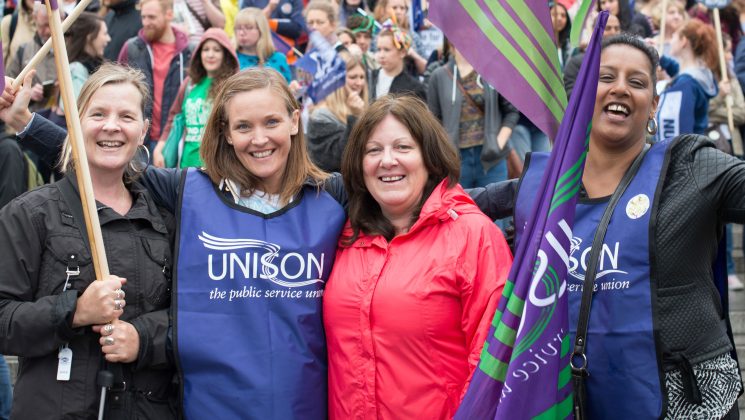
A dangerous new front has opened in the battle for workers’ rights. Reform UK has sparked outrage by proposing to “rip up” the Equality Act 2010, claiming it fuels a “divisive culture.” UNISON, the UK’s largest trade union, has issued a scathing response, warning that such a move would trigger a “race to the bottom” in the British workplace.
By attempting to scrap the laws that prevent discrimination, Reform UK is potentially inviting unscrupulous employers to return to a time when unfair treatment was not just common, but legal. For the 1.3 million members of UNISON—the vast majority of whom are women—this is not a theoretical debate. It is a direct threat to their livelihoods.
Andrea Egan: “When Working-Class Women Organise, Nothing Can Stop Us”
Speaking to a packed hall at the UNISON National Women’s Conference in Liverpool in February 2026, General Secretary Andrea Egan delivered a defiant message. Grounding her leadership in her own history as a trade unionist, she stated:
“As a union we have always stood for equality—for women, for Black members, for disabled members, for LGBT+ members, for all who face discrimination. And I want to be absolutely clear: I stand proudly and unequivocally in defence of LGBT+ rights… Equality is not negotiable.”
Egan made it clear that the target on the Equality Act is a target on the very people who keep the country running. She reminded the delegates in Liverpool that the strength of the union is its diversity:
“Our movement must always be a home for all women. For those who are black, those who are disabled, those who are LGBT+. Solidarity is not a slogan. It is a practice.”
Anti-Equality = Anti-Women: The Reality of the 1970s
It is a historical fact, demonstrated over decades, that when equality legislation is weak, women suffer first and most severely. Before the Sex Discrimination Act (1975) began a long battle for justice—a journey that only reached its peak with the comprehensive Equality Act 2010—women were trapped in a state of legalised second-class citizenship, where their livelihoods and bank accounts were subject to male gatekeeping.
1. Financial Gatekeeping & The Mortgage Barrier
In the 1970s, a woman’s income was often treated as “unreliable” by lenders. Building societies routinely refused mortgages to single women, regardless of their professional success. Married women fared no better; they were frequently denied credit for basic household appliances or mortgages unless they could find a male guarantor—usually a husband or father—to sign for them. Without these laws, women were effectively “non-persons” in the eyes of the bank.
2. Sexual Policing and Intrusive Questioning
Before the 2010 Act provided a unified shield against harassment and bias, women were subjected to humiliating personal scrutiny. During job interviews or professional assessments, it was common for women to be interrogated about their sexual activity, their choice of contraception, or their future plans for a family. Employers used their private lives as a justification to deny them promotion or stability.
3. The “Women’s Grade” and Pin Money
Before equal pay protections were fully realised, industries often operated a “women’s grade” of pay. Women were legally paid significantly less than men for work of equal value, dismissed by bosses as merely earning “pin money”—disposable income for treats rather than a living wage.
A Universal Threat: Why Equality Matters for All
It is not just women who stand to lose. History has shown that without the firm hand of equality law, minorities and marginalised groups are treated appallingly. The Equality Act 2010 synthesised protections that stopped employers from acting on their worst prejudices. Without it, we risk returning to a world where:
-
Race Discrimination: Before the Race Relations Acts were strengthened and consolidated, “colour bars” were a common sight in British housing and employment.
-
Anti-Gay Discrimination: Until the early 2000s, it was perfectly legal to fire someone simply for being gay. The Equality Act ensures that sexual orientation is a protected characteristic.
-
Disability & Mental Health: The Act forced employers to make “reasonable adjustments.” Before this, disabled workers were often dismissed as “unfit” rather than supported. Today, the 28% disability employment gap remains a challenge, but the Act provides the only legal leverage for workers to demand the tools they need to do their jobs.
-
The Age Penalty: Older workers were routinely pushed out to “make room for youth,” while younger workers were exploited for sub-minimum pay. The Act ensures that age cannot be used as a blunt instrument to terminate a career.
Conclusion: No Going Back
Those who wish to “ditch” equality laws are asking to turn back the clock 50 years to a time when discrimination was a standard business practice. As UNISON Assistant General Secretary Jon Richards warned:
“Reform is firing the starting gun on the race to the bottom… Without the Equality Act, unscrupulous employers would be free to treat staff terribly with little chance of ever being challenged.”
The protections we have today were not “given” to us; they were won through strikes, tribunal battles, and the persistent organising of working-class people. Under Andrea Egan’s leadership, UNISON has made it clear: we will not go back to the days of male guarantors, “women’s grades,” or legalised prejudice.
As Egan told the women in Liverpool: when we stand together, “nothing can stop us.” The “race to the bottom” ends here.